Showing posts with label cost savings. Show all posts

Thursday, August 14, 2008

Horrible Harmful High Housing no more...

Thought you might enjoy reading about some of my adventures.  Redwood Camping - photo by Light. ©2002-2008 Bonnee Klein Gilligan. All rights reserved.

For 3 years my husband and I traveled around the country, without a home and everything we owned in our very small car. We camped in a lot of great places, met many wonderful folks and were invited to stay in many homes. It was an amazing spiritual journey.

We crossed the USA about 4 times driving through all the states at least once except Alaska and Hawaii. Spent a little time in Canada andMexico camping - photo by Light. ©2002-2008 Bonnee Klein Gilligan. All rights reserved. Mexico too. Our very favorite place was anywhere in the redwood trees. The photo above left is our home in the majestic redwood forest. Cool, crisp and filled with critters. We had owls, deer and fox come for a visit. The photo right is our home on the beach in Mexico. It was beautifully steamy by the Sea of Cortez. The photo below is our home by a rushing stream in Utah. The stream was singing its' song of creation so loudly, we finally succumb to earplugs. Snigger! We've had thousands of homes. Everywhere we stopped to lay our heads was home. The saying, 'Home is where the heart is' was our life.Utah Camping - photo by Light. ©2002-2008 Bonnee Klein Gilligan. All rights reserved.

It's an interesting experience living without running water or electricity. We loved it. We didn't label it as green or eco-friendly or even low impact. Though I suppose it was. Our car often got 45 to 50mpg. Maybe we were hypermiling, we called ourselves blessed. We had all the comforts of home including an air mattress with feather bed and down pillows. Solar shower bags with hot water for bathing and doing dishes. Once in a while for fun we bathed in cold streams or waterfalls. Burrr... refreshing! Had 2 cook stoves and complete kitchen gear. We bought local produce at roadside stands because it was convenient, tasted better and was usually cheaper then grocery stores. Then dined on simple homemade meals in the fresh air. Ever notice how food tastes better outdoors? We woke up in forests, by lakes or oceans, in fields or deserts. What scenery, what beauty, what majesty!

I won't lie to you, this lifestyle was harder. Packing and unpacking the car. Really conserving precious water. Everything we carried had to serve several useful purposes. Space was very limited, we couldn't acquire. When we did something else had to go. Living simply was natural. Sometimes what seems to be less is actually more. When we finally decided to set down in Arizona and moved into a small 400 sq. ft. efficiency apartment we felt like we were living in a palace. Everything is perspective it seems.

I loved life on the road, but decided I enjoy nesting and going out for adventures now. I've owned and lived in large homes, but prefer them small and cozy or using today's buzz words low impact, green living, sustainable homes.

Here are a few more small low impact homes I love...

Cabin Dream - 1800s beautifully renovated guest cabin

Randy's Cabin - photo by Light. ©2002-2008 Bonnee Klein Gilligan. All rights reserved. Located in Tennessee. 1800s log cabin, dis-assembled, numbered, moved and rebuilt in its' existing location by the owner. With added space for kitchen and bathroom. 700 sq. ft. including loft bedroom. 3 acres of rolling grassy land with organic flower and vegetable gardens and a large pond.

Porch Gathering - photo by Light. ©2002-2008 Bonnee Klein Gilligan. All rights reserved. Features: Original logs, salvaged wooden floors, windows and doors. Composting toilet. Propane heat and cooking stove. Well water. Gray water reclamation. Organic gardens.

During our road journey we had the privilege to stay in this guest home several times. The photo above is all of us gathered on the deck of the cabin. I'm the one on the far left, my late husband is standing in the middle.

How to build a log home Information about building log homes.

A Hobbit House - lovely, creative, imaginative living

Cob House photo by Gary Zuker Located in Austin, TX, just up the hill from Lake Travis. 900-square-foot Leichtlehmbau modified cob (straw and clay) energy efficient home on 2 acres of wooded land. 3 people - 3 yrs. to build including 1 yr. to dry. Built by owner Gary Zuker who wanted to build a low-maintenance weekend get-a-way home for $10,000. Finished house, well, appliances and Cobhouse Model - photo by Gary Zukerseptic estimated cost $40,000 not including Gary's labor. Photo right is a model of the house before it was built.

Features: Rock foundation and chimney. 18"- 24" inch thick walls made of Leichtlehmbau cob-type material (more straw and only clay) increases insulation. Wood framing embedded in Leichtlehmbau. Dries to a strong, dense mass, 25-40 Lb/cu.ft. Post and beam frame. Finish, exterior: white lime and sand with fibers, then whitewash (white lime, water, rocksalt, alum). Interior: Gypsum Plaster. Salvaged pine floors, floor joists, granite, windows, soap stone and cabinets.

Building with Cob workshops Natural Homes cob building courses. Photos of cob building and more workshops from House Alive!.

Extremely Tiny House - home to go

 Jay's House - photo for Tumblewheed Tiny House Company Located on planet earth, but resides mostly in Sebastopol, CA. In 1997 Jay Shafer built his first 96 sq. ft. house on wheels himself for around $10,000. Today Jay owns Tumblewheed Tiny House Company which offers plans, books and truly tiny homes for sale. The Epu shown left is 88 sq. ft. and weighs only 4700 lbs. It comes with a tiny fireplace, living room, kitchen with  tiny refrigerator and 2 burner stove, wet bath and sleeping loft. Pull away price $42,997.

Features: Designed with thoughts of light, warmth, energy efficiency, and proportion. Propane cost to heat and cook about $5 per month according to one owner of a tiny house. 16 Tiny house plans available for homes from 65 to 774 sq. ft.

Learn how to build a truly tiny home workshops available.

Some more interesting links about low impact housing...

Low Impact Housing Listing of low impact housing resources Cusato Cottages Plans for inexpensive small cottage style homes Resources for Life and Small House Society Low impact ideas    Sustainable House Plans Links to sites which offer building plans

Thursday, August 7, 2008

Horrible Harmful High Housing

Houses gassing off. Carpets, insulation, paint and more. So tight and filled with chemicals they're sick houses. Literally! The building materials are bad for us. Real bad. Have been for years now. Since the '50s we've had Horrible Harmful Housing.

I remember back in the late '70s when I was a young thing living in Pennsylvania. Me and my best beau (that's us in the photo, weren't we cute!) would stop for a look see at houses from time to time. Was fun... we loved it. Once we pulled into a mobile home lot and took a tour. It was hot that day. The sun was frying eggs. Walked in one home. Looked around a bit. It was really nice inside. Could imaging living there. The longer we spent ooing and awing the more our eyes burned and watered. When we both started coughing we beat it out of there fast. Talked about it as we drove away. Said to each other, "We're protected for sure. Thank you God." Came to the conclusion it musta' been the formaldehyde. That was the buzz word back then. The stuff in the insulation that gassed off and made folks sick. They were ripping it out of all the schools.

But it's still used in some building materials. Read an article at ABC News dated July 9, 2008, "Makers of Katrina Trailers Grilled by Congress." The mobiles that were bought as temporary housing for hurricane Katrina victims were filled with it. Made some folks sick. Huh. Scratching my head. They were ripping it out in the early 80s why is it still used? In our modern society can't we come up with affordable housing that is people and earth friendly???

Well that got me curious about green housing. Sustainable, affordable, earth friendly? I like words and always find it interesting to look at dictionary definitions. Here is what I found in the Oxford American Dictionary and dictionary.reference online.

The definition of the word sustain: to support; to keep alive; to endure without giving away. To keep in existence; maintain. To supply with necessities or nourishment; provide for. To support the spirits, vitality, or resolution of; encourage. Definition of sustainable: capable of being sustained or maintained. Capable of being continued with minimal long-term effect on the environment. How interesting.

So what does sustainable mean with regard to housing? Here are definitions of sustainable housing I found online:

Sustainable Housing: Affordable and comfortable. Climate appropriate design which minimizes or eliminates the need for artificial heating and cooling. Design and construction which maintain sites natural resources. Collect and efficiently manage water resources. Management of own waste on site including greywater and black water. Produce and efficiently manage electrical power. Provide food resources from a permaculture garden. The house becomes part of the local ecosystem. Use of building materials which are recycled or made from renewable resources.

I enjoy housing designs which are unique and creative. So I did I a search. Found lots of stuff on natural or recycled building materials. Lots from companies building passive solar and other things. I was looking for something more then your average home... something fun, unique, affordable, beautiful, sustainable, earth and people friendly. Here are a few of the inexpensive homes I liked a lot....

A low impact woodland home - beautiful, natural living

Wales woodland home Located in Wales, UK. Built with maximum environmental regard by 2 people and passersby. 4 months start to finish:  1,000-1,500 man hours. Cost: about £3,000 (£60 per sq. ft., not including labor). Part of Lammas ecovillage project a carbon neutral, low impact development.

Features: Dug into hillside for low visual impact and shelter. Stone/mud at site used for retaining walls, foundations etc. Framed with oak from local woodlands. Reciprocal roof rafters. Straw bales in floor, walls and roof. Plastic sheet and mud/turf roof. Reclaimed wood floors and fittings. Reclaimed windows, burner, plumbing, wiring, etc. Lime plaster walls. Breathable and low energy to manufacture. Heat is wood burning stove - renewable and locally plentiful. Flue through thick stone/plaster. Retains heat. Slowly releases for even warmth. Fridge cooled by underground air through foundation. Skylight in roof. Solar panels for lighting, music and computing. Water gravity system from nearby spring. Composting toilet. Rainwater from roof collects in pond for garden, etc.

Building workshops available. Learn how to build a low impact woodland home.

Thanks to Pipa's Porch for directing me to this wonderful home.

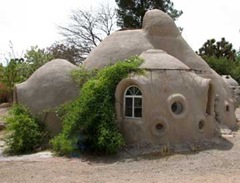
Eco Dome Earth Dwelling - a small gnome-like homedomepod-home1web

Located in California, USA.  House built by students to learn about Superadobe coil construction. Very small, 400 square foot, very low cost. Easily built by 3-5 people. Part of the Cal-Earth educational and research program.

Features: Built from local earth-filled Superadobe coils (soil-cement or lime-stabilized earth) and barbed wire. On site soil utilized, coil bags low cost. Covered with adobe. Tree free. Main dome and four niches, very low cost. Can be repeated and joined together to form larger homes and courtyard houses. Very thick walls have significant thermal mass, which reduces heating and cooling costs. It also provides sound insulation, structural integrity, fire and pest protection. Designed with the sun, shade and wind in mind for passive cooling and heating. Wind-scoop can be combined with a rated furnace unit. Solar energy and radiant heating may be incorporated. Water collection and reclamation can be incorporated. It is estimated that a four-bedroom, 2,000 square foot house would cost $75,000 ($37.50/sq. ft.) to build, including labor, materials and utilities.

Building workshops available. Learn how to build with Superadobe coils online or apprentice at Cal-Earth.

Sculpted concrete homes - Live in Art

Living Art concrete home by Flying Concrete Located in Mexico. Beautiful, imaginative custom, free flowing, sculptured concrete homes built by Flying Concrete. House shown is 700 square foot with various out buildings. Has been a design-as-you-go, evolutionary, spontaneous project. Built by 2 people.

Features: Roofs built with lightweight aggregate. Walls are lightweight concrete or local rock. Vaulted roofs – 400 year guarantee. Solar green house and other interior solar spaces.  Passive solar heat and good insulation. Water recovery systems.  Detached composting toilet. Low cost units as low as $25 per sq. ft. (2005). Roof represents 10-15% of cost.

Building workshops available. Learn how to build a sculptured concrete home.

Whoo Hoo!!! There are lots of great healthy, natural, beautiful and affordable alternative building techniques that I can learn and do myself. This is so great I can't wait to get started. Now if I only had a plot of land...


There are a lot more green and sustainable building methods, I've only mentioned a couple. Here are some links to additional stuff:

Green Home Building is a website which talks about sustainable architecture and natural building.

Natural Building Network is an association which promotes natural building principles, materials and practitioners worldwide.

Green Builders Directory a listing of various builders who build green and sustainable housing.

Thursday, June 26, 2008

Enormous Edacious Electric Eater

My electric bills are enormous. Every month it seems they get bigger and bigger. No matter what I do my habitat keeps edaciously eating energy. It's an Enormous Edacious Electric Eater. Sucking down more and more and even more. The electric conditioner of the air is eating all my earnings. Gobbling $$$$ bills like there's no tomorrow. And that cold food box seems to never stop it's gluttonous gobbling. I hear their voices day and night, whirling, whispering and whining their ravenous 'feeed meeeee'. Like giant stomachs growling their desire for more fuel. Then rudely making belching noises... ssscccuuueeww bbbuuuurrrpp... and turning themselves off. For now.

My artist friend refuses to feed the monster. He's opted to sit in 105 degree hot. Shake and bake. Rather then fork out the extra cash for cooling. So he sweats or freezes in blissful misery. He told me the other day, "It's so hellaciously hot my oil pastels melted and ran together. Now I've got an oil shadowbox by G_d. Think I'll frame it for posterity to remember this hell. Oy vey! " Clicking my tongue I replied, "Stop your kvetching! Turn on the cooler so YOU don't melt." Sheesh!

The next door neighbors on the other hand have the air cranked up so high you instantly turn into a giant popcicle upon entering. Told them so and they replied, 'Naw, you're a Creamcicle... cold and tart on the outside with a sweet creamy center." Gawd, now I'm blushing. Hate it when I blush.

My habitat is in between freezer and oven. Comfortable. But have an enormous electric bill. Got to ease it. Hiss a sigh, rubbing my mouth and neck in utter frustration. My roommate is watching this drama unfold from the sofa. "What's got you so flustered" she says. I reply, "I've got an Enormous Edacious Electric Eating apartment. My bills are so high, my wallet's going dry." She says, "There are lot's of things we might be able to do. Let's think about it for a while."

We got our heads together, wrote down our ideas. Then looked online to see what others were suggesting. Here's our finalized list things with a we opted to do:

Air conditioning / heating

Thermostat. Temperature.

  • In Summer turn off the thermostat and open the windows at night and use ceiling fans. If night temps fall into the 60s, will cool the house down. Close the widows at dawn to retain. House may stay comfortable until early afternoon without air conditioning. In Winter turn down heat to 55 degrees at night. During day set at 65 degrees and wear a sweater. Use space heater if needed as supplement.
  • 10 degrees (cooler or warmer) at night or whenever no one is home. 8 hours per day can save 10% on electric bill.
  • Install new thermostat Allows automatic adjustment.  8 hours per day can save 10% on electric bill.

Air-conditioning/heating unit.

  • Regularly maintain air-conditioning/heating unit have system checked and maintained yearly. Our landlord does yearly maintenance of all heating/cooling units.

Filters.

  • Replace filters regularly check heating/cooling system filters monthly and clean or replace if necessary. Our landlord provides filters and asks us to change them monthly.

Shades/blinds/curtains

  • Close shades (blinds or curtains). if it's cold or hot closing shades insulates the windows and can reduce costs. We have double cellular translucent shades and vertical blinds that we close during the afternoon or whenever we are gone.
  • Upgrade Shades to special shades or curtains with R value saves even more.

Ceiling Fans

  • Ceiling fans will balance the temperature in a room and help it feel cooler. Our landlord provides ceiling fans in living room and bedroom and we utilize them.

Plant trees.

  • Plant Trees can cut heating/cooling bills up to $250 annually by shading and insulating the house. We asked if we could plant a few shade trees. They were yearlings so will take a while to mature into full shade trees. One fast growing tree we planted was a mulberry. We get to enjoy the fruit too.

Weatherize

  • Leaks find and fix around windows and doors. Find with smoke or candle flame, when flickers there is a leak. Caulk or install weather stripping. Can save up to 30 percent annually on utility bills. We caulked around all the outside doors and windows, installed weather stripping and door sweeps.
  • Replace windows with more energy efficient ones if possible.
  • Leaks in HVAC ducts. Sealing and insulating ducts may save 10% annually.
  • Close chimney flues. Our apartment has a wood burning fireplace. So we opted to always keep flue closed when it's not in use.

Insulation

  • Inspect insulation levels. 12 inches of insulation in the attic can save 20% on energy costs.
  • Solar attic fan removes hot air from attic. May save around $100 during the summer season.
  • White roof reflects heat, black absorbs heat.  Our landlord recently coated the roof with a white sealant to waterproof and reflect some of the heat.
Lighting

Light bulbs.

  • Compact fluorescent bulbs (called CFLs) use 75% less electricity and last about 10 times longer then incandescent bulbs. Replacing four 100-watt bulbs with  23-watt CFLs (equivalents) will save up to $200 in three years. We replaced all of our bulbs throughout the apartment with corresponding wattage CFLs. Sometimes the out put wasn't as great, but it was satisfactory.
  • 20-watt desk lamp. light desk instead of room. One 20 watt bulb (vs. one 60 watt) will save $5 every 500 hours. We already had and used a desk lamp and opted to keep it off as much as possible.
  • Turn off lights when not needed or when leave a room.
Home Electronics

VCRs/DVD players. TVs. Stereos. Telephones.

  • Unplug home electronics. Home electronics continue to use electricity even when turned off. In fact anything with a clock, remote control or an on/off light drains power.  Idle TVs alone cost around $5 annually. Easy solution: Plug electronics into a power strip and use as on/off switch. We bought 3 surge protector strips with on/off buttons. Plugged electronics into them and turn the strips off when not in use.

Television

  • Invest in LCD TV Want to replace your TV with a large screen? Consider LCD TV, uses half the power of plasma TV.
  • Turn off and unplug the Television if no one is actively watching it.
  • Watch less or no Television Since there really wasn't anything we wanted to watch and we spent most of our time watching reruns or flipping through channels, we canceled the cable TV. Still use the TV set to watch movies that we own or rent. Gave us a bunch more time to read, talk and spend time with family and friends.

Computers

  • Laptop computers. use 85% less power so can save up to $140 annually. 
  • Set PC to automatically 'standby'. after 10 minutes being idle. All programs and work is still on the desktop ready to utilize again when mouse moved or key depressed. We have 2 computers and they 'standby' in 10 minutes and turn off if not in use 1 hour.
  • Flat panel computer monitor. uses 1/3 less electricity then CRT monitors. We're half way there. One computer has a flat panel. The other has the older style monitor.
Appliances

Energy Efficient Appliances

  • Energy Star appliances are energy efficient so use less power. All of our appliances are Energy Star rated. But all are older models so most likely we could do better. Maybe when our landlord replaces them.

Refrigerator

  • Refrigerator temperature. set to 38-40 degrees Fahrenheit. 5 degrees lower costs around $5 annually.  Defrosting freezer saves a few $ more.  Open doors less often. Freezer temperature. set to 0 degrees Fahrenheit. We bought a thermometer and monitored settings until they were optimum.
  • Clean condenser coils. dusting coils helps refrigerator run efficiently.
  • Replace old appliances. older model refrigerators and freezers can cost more then $100 annually. Energy Star refrigerators use about same power as a light bulb.

Stove / Oven

  • Small kitchen appliances. Instead of range/oven using microwave, toaster oven and/or slow cooker can save up to 75% in power costs. Plus kitchen stays cooler too.
  • Electric teapot or microwave for quick boiling water.

Washer/Dryer

  • Wash clothes in cold water, dry full loads. Clean dryer lint filter after each load, stop dryer just as clothes are dry. Line dry when/if possible.
Hot water

Hot Water Tank

  • Water temperature. Set to 120 degrees. We checked the temperature and turned it down from 125 to 120 degrees.

Shower heads and faucet aerators

  • Water-saving shower heads and faucet aerators can reduce electricity costs for a family of 4 by $250 annually. Our landlord already provided water-saving (restricting) showerheads and faucet aerators.

Showering

  • Shower instead of bathe. Taking a shower instead of a bath uses less water and energy. Except when one of us want the luxury of a bath with bubbles, candles, wine and full relaxation.

Dishes

  • Washing by hand. When washing dishes by hand use a basin filled with hot soapy water. Rinse with cold water. We don't have a dishwasher in our apartment.
  • Dishwasher. Wash full loads. Let dishes air dry.

We did all of the things we could do and began to see savings almost immediately. The electricity bill was almost cut in half. I'm dazed and amazed. Show my roommate the electric bill.

We jump, slap palms in a high five, start dancing and singing (to the song 'Jump for Your Love' by the Pointer Sisters)...

I'll take you down, I'll take you down
Where no one's ever gone before
And if you want more, if you want more
More, more, more
Jump feel my touch
Jump in and you'll go down
Jump I turn you down and my wallet feels alright
Jump, jump feel my touch

We reduced our carbon footprint again. I'm happier. My wallet is happier and the earth is happier too. Whoo Hoo!!!

A couple of links:
http://hes.lbl.gov/
http://www.10money.com/electric.htm